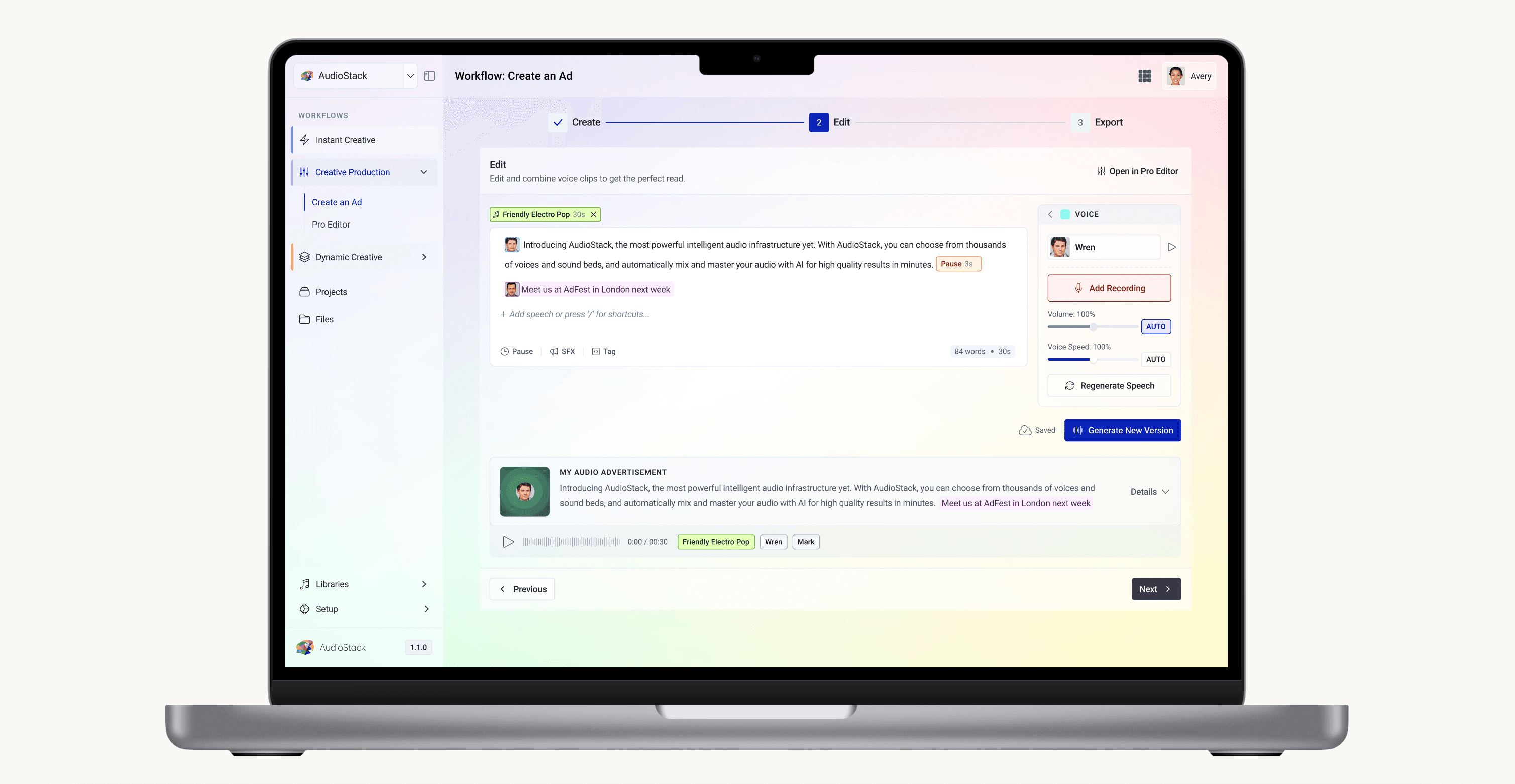
AudioStack: Making audio ad production scalable with AI
The advertising industry demands faster, more cost-effective content production without sacrificing creativity or quality. AudioStack meets this challenge by leveraging AI to revolutionize ad creation. AudioStack delivers end-to-end solutions, including ad generation from briefs, advanced text-to-speech, voice cloning, and automated versioning, enabling users to produce studio-quality audio ads in minutes.
As a product designer, I joined the team to tackle a critical challenge:
Empowering both non-creatives and seasoned professionals to produce high-quality, dynamic ads at scale, using the power of AI.
Category
AI, Audio Production
Advertisement
2025
Product
6 (1 Designer)
Challenges
The advertising industry is under pressure to scale faster and more cost-effectively, yet it remains constrained by rigid processes and a workforce new to AI. At Audiostack, we faced the challenge of designing a product that bridges the gap between non-creative who need to quickly turn ideas into convincing ads, and creatives, who require fine-grained control to refine and perfect those demos.
Audiostack’s solutions span the entire ad workflow, from creation to versioning and broadcasting. However, each stage is typically owned by different personas, each with unique needs and skill sets. Our goal was not only to ensure seamless usability for all users, but also to future-proof the tool. As the industry evolves, roles are becoming more fluid, with AI enabling professionals to take on tasks across multiple domains. Our design had to anticipate and adapt to these shifts, empowering users to work more efficiently and collaboratively in an AI-augmented landscape.
Methodology & Results
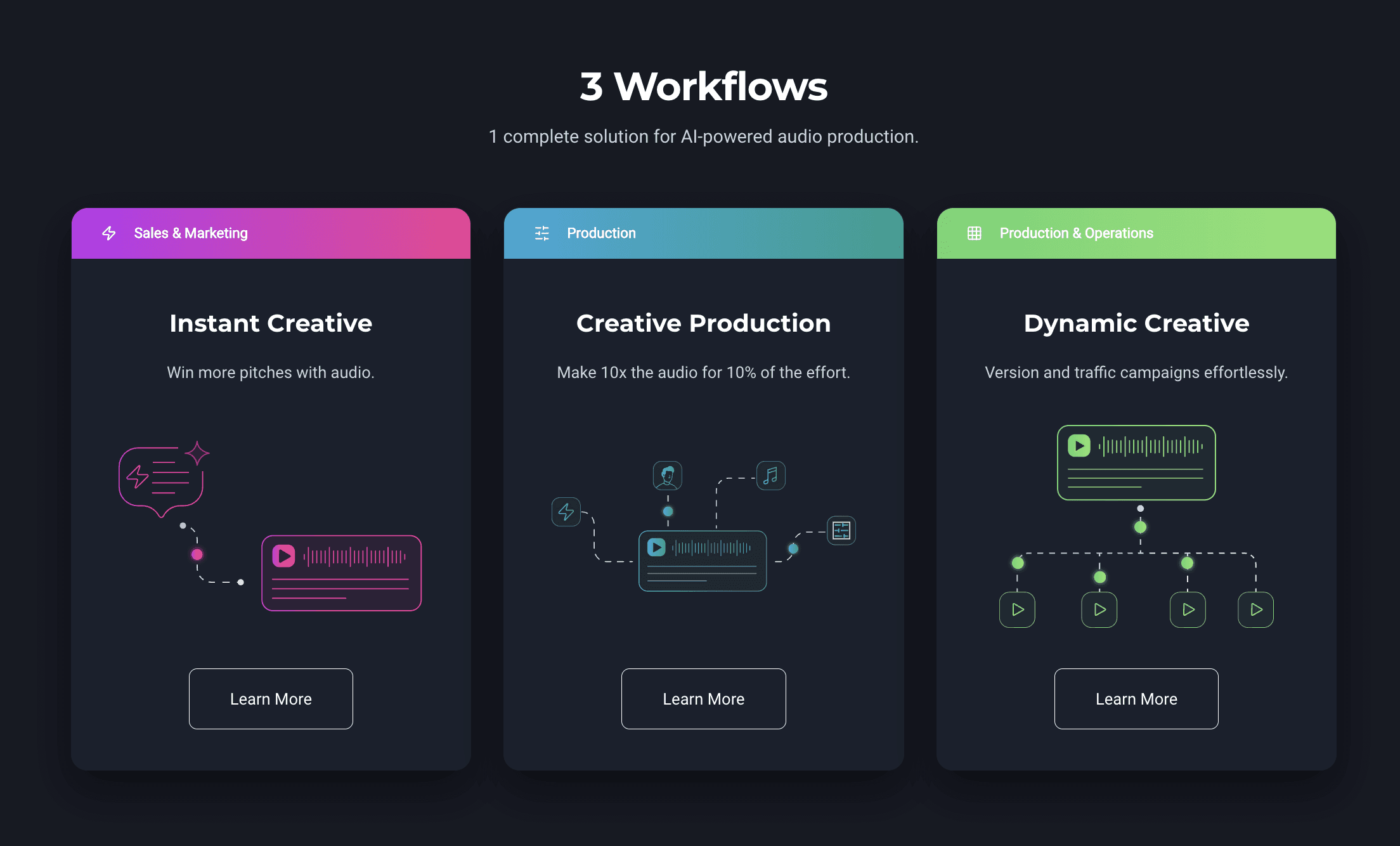
After observing conversion rates and other analytics, interviewing some of our client & users, we realised users had trouble creating ads with all the different disparate features we had on the platform. From where me and the Product Owner conducted several workshops to see how we could reduce friction points and find new solutions that were technically possible & perfomant. Once the new workflows were designed and approved we very quickly shipped a beta version we tested with key customers and our power users.
What I learned
By reorganizing disparate features into guided workflows, we established a clear, goal-oriented product structure. This not only was a simplified the user journey but also reinforced Audiostack’s identity as a tool for efficient, high-quality audio ad creation.
Working on this product reminded me that good design is about making things easy. At first, the features were all over the place, useful, but not intuitive. By reorganizing them into intuitive, guided workflows, I realised how a clear, goal-oriented approach can transform both the user experience and the product’s identity. It was a great exercise to see how something as simple as reorganizing features could make the whole product feel more cohesive and purposeful.
This wasn’t just about tidying up a UI, it was about helping people do their best work faster. And in the end, it didn’t just improve the user experience, it made Audiostack feel like the go-to tool for creating great audio ads.